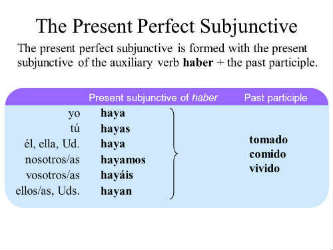
The present perfect subjunctive is formed using the formula:
present subjunctive conjugation of haber + the past participle = present perfect subjunctive
Below is the present subjunctive conjugation of the helping verb haber with the past participle of hablar (to speak)
| |
|
| yo |
 haya hablado haya hablado
|
| tú |
hayas hablado
|
| Ud./él/ella |
haya hablado
|
| nosotros (as) |
hayamos hablado
|
| vosotros (as) |
hayáis hablado
|
| Uds./ellos/ ellas |
hayan hablado
|
There are two possible English translations for the present perfect subjunctive:
haya hablado - I spoke (or) I have spoken
hayas hablado - you spoke (or) you have spoken
hayamos hablado - we spoke (or) we have spoken
The present perfect subjunctive is used in the same types of clauses as the present subjunctive, and normally is used: to indicate the action as completed with governing verbs in the present or future tense or command forms. Let's look at some example sentences:
Lamento que el producto no haya cumplido con sus estándares.
I apologize that the product was not up to your standards.
Lamentamos que haya tenido problemas con el producto.
We are sorry you had a problem with the product.
Estás contento de que haya llegado.
You are content that he has arrived.
Sentences with haya hablado
Sentences with hayas hablado
Sentences with haya hablado
Sentences with hayamos hablado
Sentences with hayan hablado
The present perfect subjunctive is used to describe what has happened in instances where the subjunctive is signaled: denial, doubt, recommendation, etc. For example: 'I hope that you have studied', 'I doubt that you have completed your homework', 'Ron is surprised that she has done it'.
Forming the present perfect subjunctive:
This structure is the same of the present perfect indicative, but the conjugations of the verb 'haber' are now subjunctive: 'yo haya' instead of 'yo he', 'nosotros hayamos' instead of 'nosotros hemos', etc.
The present perfect subjunctive forms for correr
Tú quieres que yo haya corrido.
Yo quiero que tú hayas corrido.
Yo quiero que él/ella/usted haya corrido.
Yo quiero que nosotros/nosotras hayamos corrido.
Yo quiero que vosotras/vosotros hayáis corrido.
Yo quiero que ellos/ellas/ustedes hayan corrido.
Placement of the pronouns with the present perfect subjunctive
The pronouns go before and separate from the auxiliary verb 'haber.'
Examples:
Direct Object:
Dudas que yo lo haya comido.
You doubt that I have eaten it.
Indirect Object:
Ellos no saben que tú le hayas escrito.
They don't know that you have written to her.
Direct and Indirect Objects Together:
No quieren que nosotros se lo hayamos regalado.
They didn't want us to have given it to him.
Reflexive
Su madre espera que ellos se hayan lavado las manos.
Their mother hopes that they have washed their hands.
Video
Video too fast or too slow for you? Change the playback speed of the video quickly. Click on "settings" icon. Select "speed". Select desired playback speed.

 Vocabulary Flashcards