Spanish Numbers - 100 to 200
You are already aware that the Spanish for one hundred is cien or ciento.
So, when do you use cien and when should you use ciento?
When there is exactly one hundred of something and the number is used with the noun, you use the shortened form cien, whether that noun is masculine or feminine. For example:
cien libros - one hundred books
cien plumas - one hundred pens
When you want to form numbers with 100, you would use ciento. For example:
101 - ciento uno (100/ciento + 1/uno = ciento uno)
114 - ciento catorce (100/ciento + 14/catorce = ciento catorce)
127 - ciento veintisiete (ciento + veintisiete = ciento veintisiete)
165 - ciento sesenta y cinco (ciento + sesenta y cinco = ciento sesenta y cinco)
Observe that "y" is NOT used to separate hundreds from tens and only used in numbers 131-199 (also 231-299, 331-399, etc).
In other words:
103 - ciento tres NOT ciento y tres
199 - ciento noventa y nueve NOT ciento y noventa y nueve
Spanish Numbers - 200 to 900
To count by hundreds, the plural form of ciento is used - cientos - along with the appropriate number, and it is written as one word.
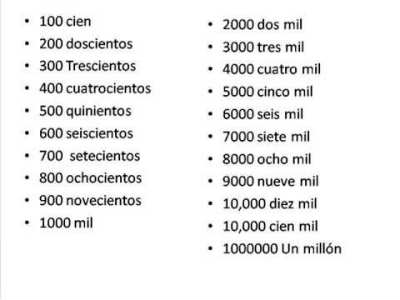
So, counting up in hundreds as far as a thousand, the Spanish numbers would be:
200 - doscientos
300 - trescientos
400 - cuatrocientos
500 - quinientos
600 - seiscientos
700 - setecientos
800 - ochocientos
900 - novecientos
Observe the slight irregularities in quinientos, setecientos and novecientos.
The Spanish numbers 200, 300, 400 etc have masculine and feminine forms. For example:
doscientos libros - 200 books (masculine noun)
doscientas plumas - 200 pens (feminine noun)
Using the Spanish numbers you have learnt so far and applying the relevant rules, here are examples of a few numbers between one hundred and a thousand.
153 - ciento cincuenta y tres
162 - ciento sesenta y dos
220 - doscientos veinte
250 - doscientos cincuenta
300 - trescientos
330 - trescientos treinta
325 - trescientos veinticinco
513 - quinientos trece
765 - setecientos sesenta y cinco
767 - setecientos sesenta y siete
777 - setecientos setenta y siete
802 - ochocientos dos
948 - novecientos cuarenta y ocho
Spanish Numbers - Over 1000
The Spanish for “one thousand” or “a thousand” is always mil, NEVER un mil. Mil is used for all multiples of a thousand: mil, dos mil, tres mil, cuatro mil, cien mil, doscientos mil, etc.
However, if one wanted to say "thousands of dollars", the plural would be used - miles de dólares .
Mi tío rico me regaló miles de dólares ayer.
My rich uncle gave me thousands of dollars yesterday.
Examples of some Spanish numbers using mil are:
1,000 - mil
10,000 - diez mil
100,000 - cien mil
1,300 - mil trescientos
1,316 - mil trescientos dieciséis
1,515 - mil quinientos quince
1,534 - mil quinientos treinta y cuatro
1,553 - mil quinientos cincuenta y tres
1,573 - mil quinientos setenta y tres
1,693 - mil seiscientos noventa y tres
1,854 - mil ochocientos cincuenta y cuatro
1,858 - mil ochocientos cincuenta y ocho
1,867 - mil ochocientos sesenta y siete
1,869 - mil ochocientos sesenta y nueve
1,870 - mil ochocientos setenta
1,871 - mil ochocientos setenta y uno
1,895 - mil ochocientos noventa y cinco
1,898 - mil ochocientos noventa y ocho
1,904 - mil novecientos cuatro
1,912 - mil novecientos doce
1,913 - mil novecientos trece
1,914 - mil novecientos catorce
3,000 - tres mil
12,855 - doce mil ochocientos cincuenta y cinco
13,000 - trece mil
20,000 - veinte mil
33,000 - treinta y tres mil
362,121 - trescientos sesenta y dos mil ciento veintiuno
380,000 - trescientos ochenta mil
3,550,000 - tres millones quinientos cincuenta mil
7,470,000- siete millones cuatrocientos setenta mil
16,000,000 - diez y seis millones
70,000,000 - setenta millones
75,000,000 - setenta y cinco millones
131,000,000 - ciento treinta y uno millones
200,000,000 - doscientos millones
264,000,000 - doscientos sesenta y cuatro millones
300,000,000 - trescientos millones
877,000,000 - ochocientos setenta y siete millones
Spanish Numbers - Millions
The Spanish for a million is un millón.
Notice that, unlike the Spanish for a thousand, you need to include the un.
The same rule applies for the Spanish number for a billion - un billón. You have to include the un.
To make the plural of millón or billón, you just add -es and remove the accent.
Examples of these higher Spanish numbers would be:
2,457,022
dos millones cuatrocientos cincuenta y siete mil veintidos
5,382,368
cinco millones trescientos ochenta y dos mil trescientos sesenta y ocho
A million things - Un millón de cosas
When millón or its plural form millones is followed by a noun, it must be linked with de:
Indianapolis tiene un millón de habitantes, pero dos millones de coches, al parecer.
Indianapolis has one million inhabitants, but two million cars, apparently.