Spanish for Kids Telling Time
Lesson
Telling Time
ser
Examples
¿Qué hora es? - What time is it?
Es la una.
Son las dos.
Son las doce.
Note: The plural form (son
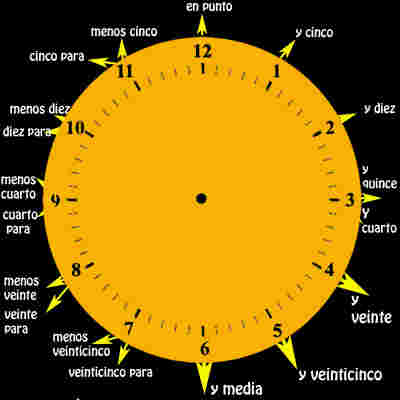
Instead of saying 15 minutes, cuarto Media
Es la una y cuarto.
A la una y media.
Note: Minutes up to half an hour are added to the hour using y menos Son las cinco y diez.
Son las tres menos cuarto.
Son las tres menos diez.
Es medianoche. - It's midnight.
Es la medianoche. - It's midnight.
a la medianoche - at midnight
Ellos toman el bus de la medianoche.
al mediodía - at noon
Eso es temprano. Yo me levanto al mediodía.
VideoVIDEO
Video too fast or too slow for you? Change the playback speed of the video quickly. Click on "settings" icon. Select "speed". Select desired playback speed.
Click on the icons below to learn more about telling time in Spanish!
Vocabulary
Sentences
Test your knowledge by taking the quizzes!
1.
Son las diez horas y veinte minutos.
Son las nueve.
Son las cinco y cuarto.
2.
Es la una.
Son las diez horas y veinte minutos.
Son las cinco menos cinco
3.
Son las cinco y cuarto.
Son las nueve.
Son las ocho y cinco minutos.
4.
Son las cinco y cuarto.
Son las doce.
Son las cinco menos cinco
5.
Son las nueve y veinte minutos.
Son las diez horas y veinte minutos.
Son las cinco menos cinco.
1.
Son las tres y media.
Son las cinco y diez.
Es la una y cuarto.
2.
Son las dos y cuarto.
Es la medianoche.
Son las tres menos cuarto.
3.
Son las cinco y diez.
Es la una y cuarto.
Es la una y doce.
4.
Son las tres menos cuarto.
Es la una y cuarto.
Tres para las ocho.
5.
Son las siete menos cuarto.
Son las cinco y diez.
Es la medianoche.
Flashcards
Quiz 1
Quiz 2
Previous Next


 Vocabulary Flashcards