There are two forms of the past in Spanish.The imperfect past and the preterite past. This lesson focuses on the Spanish preterite which indicates that an event took place at some point in the past and it is a completed finished action. Let's look at some preterite sentences as examples:
Preterite sentence examples
caminar (to walk)
Yo caminé al parque. - I walked to the park. Él caminó en la calle. - He walked on the street.
Yo caminé en la playa. - I walked on the beach.
correr (to run).
Yo corrí dos veces. - I ran two times. Nosotros corrimos en el jardín. - We ran in the garden.
There are many irregular verbs in the Spanish Preterite:
ir (to go)
Yo fui a Francia. - I went to France. Él fue a México por avión. - He went to Mexico by plane.
dar (to give)
Yo di una mano. - I gave a hand. Ellos nos lo dieron. - They gave it to us.
Spanish past tense sentences
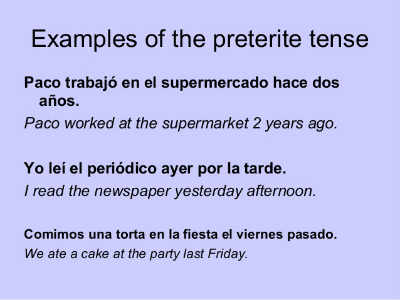
The Spanish preterite indicates that an event took place at some point in the past and it is a completed action. Let's look at some examples:
¿Cuántas galletas comiste? - How many cookies did you eat?
Ellos jugaron fútbol ayer. - They played soccer yesterday.
Sólo dormí una hora, pero cuando desperté, me sentí descansada.
I only slept for one hour but when I woke up, I felt rested.
Nosotros cantamos una canción buena en la discoteca.
We sang a good song at the discotheque.
In the preterite we are speaking of a one time event and we can focus in on a particular moment. We could pin down a specific moment, when the money was exchanged or when they signed the bill of sale. This is the idea that we express with the "preterite". For most verbs in English we simply add "-ed" to the end of the verb for the past. In many cases, however, English uses unpredictable irregular forms for the past. The form "sold" would be an example of this. Actually, "sold" really means "selled" (although, of course, we don't actually say it that way). What's important to remember is that in English, the simple past can be interpreted to mean "used to do" or "was doing", but also it can mean a single one time event that took place at a particular moment in the past. This is what we want to focus on now.
Here are the forms that we use in the Spanish "preterite" forms to express one time events that took place at a particular moment in the past. Notice that instead of dividing the verb into three parts, we only have two parts, the stem and the ending. For now, we are going to focus on "A" category verbs.
I spoke - yo hablé
you spoke - tú hablaste
he/she spoke - él/ella habló
we spoke - nosotros hablamos
they spoke - ellos/ellas hablaron
One point that it's important to notice. The preterite past form for "nosotros" looks and is pronounced exactly the same way that the present form would be. For example, "nosotros hablamos" could mean "we are speaking" or "we spoke". We would have to get the exact meaning from the context in which it is used in the sentence.
Let's break the forms down into stem and ending so that we can see a little more clearly how this form is constructed.
habl é
habl aste
habl ó
habl amos
habl aron
Now let's practice building some sentences in which we use the "preterite" past form of the verb to express a one time event at a particular point of time in the past.
I bought a gift (un regalo) for my friend. Yo compré un regalo para mi amigo(a).
Did you buy a gift for your friend? ¿Compraste un regalo para tu amigo(a)?
Mary bought a gift for her friend. María compró un regalo para su amigo(a).
Vocabulary Flashcards Vocabulary Quiz Photo Quiz Spelling Quiz Sentence Flashcards Video Example Sentences Dialogue Image-Sentence Match Word Order Quiz Multiple Choice Quiz A or B Quiz Fill In
Icon Legend
Icons are color coded by Spanish level:
Green = Beginner Blue = Intermediate Orange = Advanced


 Vocabulary Flashcards